makeup for pictures tutorial

Navigating the world of makeup for photoshoots can feel daunting, but it doesn’t have to be! This tutorial, created with expert guidance, will empower you to achieve a flawless, camera-ready look.

Professional lights and cameras significantly impact how makeup appears, often washing out color. Understanding these nuances is key to ensuring your best self translates beautifully in every shot.

We’ll explore techniques to enhance your features, correct imperfections, and create a lasting impression, ensuring you feel confident and radiant in front of the lens.

Why Makeup Looks Different in Photos

The camera doesn’t see makeup the same way the human eye does. This is a fundamental concept in understanding makeup for pictures. Studio lighting, and even the flash on your phone, dramatically alters how colors and textures appear on camera.

Specifically, bright lights tend to flatten features and wash out color intensity. What looks like a subtle blush in person can disappear entirely in a photograph. Similarly, a natural lip color might register as almost nonexistent. This is because the camera captures light reflecting off your face, and strong light sources can overwhelm delicate makeup applications.

Furthermore, the camera exaggerates certain textures and imperfections. Pores, fine lines, and uneven skin tone become more prominent. Therefore, a heavier hand with foundation and concealer is often necessary to create a smooth, even base. It’s crucial to remember that makeup for photos isn’t about looking “natural” in person; it’s about looking fantastic on camera.

Essentially, you need to amplify your makeup application to compensate for the camera’s effects, ensuring your features are defined and your color choices are vibrant.

The Importance of Camera-Ready Makeup

Investing time in camera-ready makeup is paramount for achieving stunning photographs. It’s not merely about concealing flaws; it’s about enhancing your features and creating a polished, confident appearance that translates beautifully on film or in digital images.

Proper makeup ensures you recognize yourself in the final photos, and that your personality shines through. Without adequate makeup, you risk looking washed out, flat, or even older than you are. A well-executed makeup application defines your bone structure, brightens your complexion, and draws attention to your best features.

Consider professional portrait sessions – makeup is a crucial step, often requiring more intensity than everyday wear. Even for casual photos, a little extra effort can make a significant difference. It’s about understanding how light interacts with makeup and adjusting your application accordingly.

Ultimately, camera-ready makeup is an investment in preserving cherished memories, ensuring you look and feel your absolute best in every photograph.

Skin Preparation: The Foundation for Success

Flawless makeup begins with a well-prepared canvas! Proper skin prep ensures smooth application, longevity, and a natural finish, maximizing the impact of your makeup artistry.

Primer: Creating a Smooth Canvas

Primer is often an overlooked step, but it’s absolutely crucial for camera-ready makeup. Think of it as the base layer that sets everything up for success, smoothing the skin’s texture and creating an even surface for foundation application.

A good primer can effectively minimize the appearance of pores, fine lines, and imperfections, resulting in a more polished look on camera. It also helps to control oil production, preventing shine and ensuring your makeup stays put throughout the photoshoot.

Primer doesn’t just smooth; it also helps makeup adhere better, avoiding patchy or clumpy application. There are various types of primers available, catering to different skin concerns – from hydrating primers for dry skin to mattifying primers for oily skin.

Choosing the right primer depends on your skin type and desired finish. If you’re unsure where to start, resources like Refinery 29 offer helpful guides to navigate the world of primers and find the perfect match for your needs;

Color Correction: Addressing Imperfections

Before applying foundation, color correction is a powerful technique to neutralize skin discolorations and create a flawless base. Cameras can exaggerate imperfections, making color correction even more vital for achieving a polished look in photos.

Different colored correctors address specific concerns: green neutralizes redness (like acne or rosacea), peach or orange cancels out blue undertones (often found in under-eye circles), and lavender brightens dullness and corrects sallowness.

Apply color corrector sparingly, focusing only on the areas that need it. Blend it seamlessly into the skin before moving on to foundation. Remember, a little goes a long way! The goal isn’t to completely eliminate the discoloration, but to neutralize it so foundation can create an even tone.

Choosing the right shade of corrector is key. Fair skin tones typically benefit from peach correctors, while medium to deep skin tones may require orange or red-toned correctors. Mastering this step ensures a naturally balanced and radiant complexion on camera.

Foundation: Choosing the Right Formula & Coverage

Selecting the right foundation is crucial for a camera-ready complexion. Remember, professional lighting tends to wash out makeup, so opting for slightly more coverage than your everyday routine is advisable. However, avoid anything too heavy, as it can appear cakey on camera.

Consider your skin type when choosing a formula. Oily skin benefits from matte, long-wearing foundations, while dry skin thrives with hydrating, dewy options. For normal skin, a satin finish offers a balanced look.

Full coverage foundations are excellent for concealing imperfections, but can be blended with a lighter formula for a more natural effect. Medium coverage provides sufficient coverage without looking heavy. Always match the foundation to your jawline in natural light to ensure a seamless blend.

Don’t forget to blend thoroughly with a brush, sponge, or your fingers, extending the foundation down your neck to avoid harsh lines. A well-applied foundation creates a smooth, even canvas for the rest of your makeup.

Enhancing Features for the Camera

Now, let’s sculpt and define! Contouring, highlighting, and blush are essential for adding dimension and warmth, ensuring your features pop beautifully in photographs.

These techniques compensate for the flattening effect of the camera, creating a more sculpted and vibrant appearance.

Contouring: Defining Your Face Shape

Contouring is your secret weapon for adding definition and structure to your face, especially crucial when the camera tends to flatten features. It’s about creating shadows to sculpt and enhance your natural bone structure. Begin by identifying your face shape – round, oval, square, or heart-shaped – as this will dictate where you apply the contour.

Use a cool-toned contour powder or cream that’s two to three shades darker than your skin tone. Apply it along the hollows of your cheeks (suck in your cheeks to find them!), along your temples, and along your jawline. Blend, blend, blend! Harsh lines are a no-no; the goal is a seamless, natural shadow. Remember, professional lights can wash out contour, so don’t be afraid to build up the intensity gradually.

For a softer look, use a fluffy brush. If you have a rounder face, focus on contouring under the cheekbones to create more definition. For a square face, soften the jawline with contour. Don’t forget to blend downwards to avoid creating a muddy appearance. A well-contoured face will appear more defined and sculpted in photos, enhancing your overall look.

Highlighting: Adding Dimension and Glow

Highlighting works in tandem with contouring, bringing light to the high points of your face and creating a beautiful, dimensional effect. This is especially important for photos, as cameras can sometimes flatten features. Choose a highlighter that complements your skin tone – champagne shades work well for fair skin, while gold or bronze tones suit warmer complexions.

Apply highlighter to the tops of your cheekbones, down the bridge of your nose, on your cupid’s bow, and under your brow bone. A subtle shimmer on the inner corners of your eyes can also brighten your gaze. Use a light hand; you want a glow, not a blinding shine. Remember that professional lighting can amplify highlighter, so start with a small amount and build up as needed.

For a natural look, opt for a cream or liquid highlighter blended seamlessly into your foundation. Powder highlighters are great for setting your makeup and adding a more intense glow. Highlighting strategically draws attention to your best features and creates a radiant, youthful appearance in photographs.

Blush: Adding Color and Warmth (More Than Usual!)

Cameras tend to wash out color, so don’t be shy with your blush! You’ll need significantly more blush for photos than you would for everyday wear – professional studio lights can diminish your natural flush by at least 50%. This doesn’t mean going overboard, but rather strategically applying a more vibrant shade to counteract the flattening effect of the camera.

Choose a blush color that complements your skin tone and consider the overall look you’re aiming for. Peach and pink tones are universally flattering, while coral shades add warmth. Apply blush to the apples of your cheeks, blending upwards towards your temples. Smile while applying to ensure the color is placed correctly.

Powder blush is a classic choice, but cream blushes can provide a more natural, dewy finish. Remember to blend well to avoid harsh lines. Adding extra color to your cheeks will ensure you look healthy and vibrant in your photos, preventing a washed-out appearance.

Eye Makeup: Making Your Eyes Pop

Eyes are the focal point, so enhance them! Camera-friendly eyeshadows, defined eyeliner, and volumizing mascara are essential. These techniques will create captivating, noticeable eyes in every photograph.

Eyeshadow: Selecting Camera-Friendly Shades

Choosing the right eyeshadow shades is crucial for a successful photoshoot look. What appears subtle in person can often get lost on camera, so it’s best to amplify your choices. Opt for shades that are a few tones deeper than your everyday makeup to ensure they translate well in photos;

Avoid overly shimmery or glittery eyeshadows, as they can create unwanted glare and flashback under studio lights. Instead, focus on matte or satin finishes that provide depth and dimension without being distracting. Warm-toned shades like browns, bronzes, and golds generally photograph beautifully, adding warmth and enhancing your eye color.

Don’t be afraid to experiment with slightly bolder colors, especially if you have lighter eyes. A touch of plum or emerald can make your eyes pop! Remember to blend your eyeshadow thoroughly to avoid harsh lines and create a seamless, professional finish. Proper blending is key to a polished, camera-ready eye look.

Eyeliner: Defining and Enhancing Eyes

Eyeliner is a powerful tool for defining and enhancing your eyes in photographs. However, a heavy-handed application can appear harsh under the bright lights of a photoshoot. The key is to build up the intensity gradually, starting with a thin line and adding more product as needed.

Black eyeliner is a classic choice, but consider using a dark brown or charcoal gray for a softer, more natural look. For a subtle lift, slightly wing out the eyeliner at the outer corners of your eyes. Smudging the eyeliner along the lash line can create a smoky effect that adds depth and dimension.

Waterproof eyeliner is essential to prevent smudging or running, especially if you’re prone to tearing up or if the photoshoot involves outdoor elements. Pay attention to your eye shape and adjust the eyeliner application accordingly to flatter your features. A well-defined eye will truly captivate the camera!

Mascara: Creating Volume and Length

Mascara is crucial for making your eyes appear larger and more defined in photos. Because cameras can sometimes wash out features, several coats are often necessary – more than you’d typically use for everyday wear. Don’t be afraid to layer the product, allowing each coat to dry slightly before applying the next to avoid clumping.

Opt for a waterproof or water-resistant formula to prevent smudging or flaking under studio lights or in outdoor conditions. Consider using an eyelash curler before applying mascara to lift and open up your eyes. Focus on coating the base of your lashes to create a fuller look.

For added drama, apply a second coat to the outer lashes. Remember, the goal is to create visible, impactful lashes that draw attention to your eyes and enhance your overall look in the photographs.

Lip Makeup: Bold Colors for the Win

Lips often appear less vibrant in photos, so embrace bold, bright colors! Natural and nude shades can get lost, while vivid hues translate beautifully on camera, adding a pop.

Lip Liner: Defining Lip Shape and Preventing Bleeding

Lip liner is a crucial step often overlooked, but it’s a game-changer for camera-ready lips. It serves a dual purpose: defining your lip shape and preventing color bleeding, especially when using bolder shades.

For photos, choose a lip liner that closely matches your lipstick color, or opt for a neutral shade that complements your skin tone. Carefully outline your lips, slightly overdrawing if you desire a fuller appearance – but keep it subtle for a natural look.

Filling in your entire lip with liner before applying lipstick creates a base, enhancing color payoff and longevity. This technique ensures even coverage and prevents the lipstick from feathering or migrating, which can be particularly noticeable in high-resolution photos.

Blending the liner inwards with a lip brush softens the lines and creates a seamless transition to the lipstick. A well-defined lip shape will photograph beautifully, adding definition and polish to your overall makeup look. Don’t skip this step – it makes a significant difference!

Lipstick: Choosing Bright, Camera-Ready Colors

When it comes to lipstick for photos, embrace boldness! Natural hues and nude tones often get lost on camera, appearing washed out or even disappearing entirely under studio lights. Bright, saturated colors are your best friend for creating a noticeable and impactful lip look.

Reds, berries, and vibrant pinks photograph exceptionally well, adding a pop of color and drawing attention to your smile. Consider your skin tone when selecting a shade – warmer tones suit coral and orange-based reds, while cooler tones look stunning in berry and blue-based reds.

Matte or satin finishes are generally preferred over glossy lipsticks, as gloss can create unwanted reflections and glare in photos. Ensure your lips are well-hydrated before application to prevent cracking and ensure a smooth finish.

Don’t be afraid to experiment and choose a color that makes you feel confident and radiant. A bold lip can instantly elevate your entire look and create a memorable photograph!

Final Touches & Avoiding Common Mistakes

Lock in your look with setting powder and bronzer for a flawless finish! Avoid white under-eye mishaps by using a light hand with concealer, ensuring a natural glow.

Setting Powder: Locking in Your Makeup

Setting powder is absolutely crucial for ensuring your makeup stays put throughout your photoshoot, especially under the bright lights of a studio. It effectively minimizes shine and prevents creasing, creating a smooth, even base for the camera to capture.

Choose a finely milled powder – translucent is a safe bet for all skin tones – and apply it strategically. Focus on areas prone to oiliness, such as the T-zone (forehead, nose, and chin), but don’t be afraid to lightly dust it over your entire face.

Application methods vary; a large fluffy brush provides a soft, diffused finish, while a sponge or brush pressed into the skin offers more coverage. Remember, less is often more! You can always build up the powder gradually to avoid a cakey appearance.

A key tip: lightly bake under your eyes with a brightening powder to further prevent concealer from shifting or appearing white in flash photography. This technique sets the concealer and creates a flawless, illuminated under-eye area.

Avoiding White Under-Eye Mishaps with Concealer

The dreaded white under-eye in photos is a common pitfall, but easily avoidable with the right techniques! Flash photography exaggerates brightness, making concealer appear much lighter than it is in natural light. To combat this, choose a concealer one to two shades lighter than your skin tone, but avoid anything too stark.

More importantly, layer your concealer strategically. Start with a color corrector – peach or orange tones neutralize blue or purple undertones – before applying your concealer. This creates a balanced base and prevents the concealer from having to work overtime.

Blend thoroughly, ensuring there are no harsh lines. Then, and this is vital, set the concealer with a generous amount of setting powder (as discussed previously!). This “baking” technique locks the concealer in place and prevents flashback.

Finally, remember that professional studio lights wash out makeup, so don’t be afraid to apply a bit more coverage than you normally would for everyday wear.

Bronzer: Framing the Face & Adding Warmth

Bronzer is your secret weapon for adding dimension and life back into your complexion, especially under the harsh glare of studio lights. Cameras tend to flatten features, and bronzer helps to sculpt and define;

Opt for a sheer, matte bronzer – avoid anything too glittery or shimmery, as this can appear unnatural in photos. Apply it strategically around the perimeter of your face: along your temples, under your cheekbones, and along your jawline.

Think of it as “painting” the edges of your face to create a subtle, sun-kissed glow. This technique not only adds warmth but also draws the eye inward, highlighting your features.

A light dusting on the bridge of your nose can also add subtle definition. Remember, the goal is to enhance your natural contours, not to create a dramatically different look. Blend, blend, blend – seamless application is key!


cadd-solis pump user manual

CADD-Solis Pump User Manual: A Comprehensive Guide

This comprehensive manual details the CADD-Solis ambulatory infusion pump’s operation, intended for clinicians and system administrators. Properly follow all warnings, cautions, and instructions for safe and effective patient therapy, encompassing various security levels and modes.

The CADD-Solis ambulatory infusion pump represents a significant advancement in medication delivery technology, designed to provide precise and reliable therapy for patients requiring continuous subcutaneous or intravenous infusions. This pump is intended for use in both hospital and outpatient settings, offering versatility and convenience for a wide range of clinical applications. It’s crucial to understand that the CADD-Solis, and particularly the CADD-Solis VIP version, delivers measured drug therapy, necessitating careful oversight by qualified healthcare professionals.

This pump is not intended for self-administration by patients; access to the operator’s manual should be restricted to clinicians and system administrators only. The CADD-Solis features multiple security levels, designed to limit access to programming functions and ensure patient safety. Before operating the pump, it is absolutely essential to thoroughly read and understand this entire operator’s manual. Familiarization with the pump’s components, operating modes (manual and programmed), and alarm signals is paramount for effective and safe utilization. The manual provides detailed instructions on loading, priming, setting infusion parameters, and managing potential occlusions.

Furthermore, understanding data retrieval, maintenance procedures, and troubleshooting common issues will contribute to optimal pump performance and longevity.

Safety Precautions and Warnings

Critical safety precautions must be observed when using the CADD-Solis pump to prevent potential harm to patients and operators. Always inspect the pump for physical damage before each use, and never operate a damaged device. Clinicians must be thoroughly trained on all aspects of pump operation, including recognizing and responding to alarm conditions. Failure to properly follow warnings, cautions, and instructions detailed in this manual could result in inaccurate drug delivery or pump malfunction.

Never attempt to modify or disassemble the pump, as this will void the warranty and potentially compromise its safety features. Ensure compatibility between the pump, infusion set, and medication being administered. Regularly check the infusion site for signs of infection or irritation. Be aware of potential occlusion risks and promptly address any alarms indicating a blockage.

Strict adherence to infection control protocols is essential during pump handling and maintenance. Do not permit patients access to the operator’s manual or pump programming functions. Always verify infusion parameters before initiating therapy, and continuously monitor the patient for any adverse reactions.

Pump Components and Overview

The CADD-Solis ambulatory infusion pump comprises several key components working in unison to deliver precise medication therapy. These include a durable pump housing, a high-precision syringe drive mechanism, a user interface featuring a display screen and keypad, and a battery compartment. The pump accepts various syringe sizes, accommodating a wide range of infusion volumes.

Essential external features include the occlusion sensor port, battery charging connector, and programming port for data retrieval and software updates. Internally, a sophisticated microprocessor controls pump operation, managing infusion rates, volumes, and alarm functions. The pump’s display provides real-time information on infusion status, battery life, and any active alarms.

Understanding the location and function of each component is crucial for safe and effective pump operation. Familiarize yourself with the pump’s physical layout and the purpose of each button and indicator. Proper handling and care of these components will ensure optimal pump performance and longevity.

Security Levels and Access Control

The CADD-Solis pump incorporates a multi-tiered security system designed to prevent unauthorized access and ensure patient safety. It features three distinct security levels: Administrator, Clinician, and Lockout. The Administrator level grants full access to all pump settings and programming functions, reserved for qualified personnel.

Clinician level allows authorized users to initiate and modify infusions within pre-defined parameters set by the Administrator. This level restricts access to critical system settings, preventing accidental or intentional alterations. The Lockout level completely disables pump operation, safeguarding against unintended infusions.

Access to each level is controlled via a unique password or access code. Maintaining the confidentiality of these credentials is paramount. Regularly changing passwords and implementing strong password policies are recommended; The pump’s security features are vital for maintaining data integrity and preventing unauthorized manipulation of infusion therapy, adhering to regulatory compliance.

Operating Modes: Manual vs. Programmed

The CADD-Solis pump offers two primary operating modes: Manual and Programmed. Manual mode allows for immediate bolus delivery or continuous infusion with directly inputted parameters, providing real-time control for urgent situations or simple infusion needs. This mode requires constant clinician oversight and precise parameter adjustments.

Programmed mode enables the creation and storage of complex infusion profiles, including varying rates, volumes, and durations. This is ideal for long-term infusions or protocols requiring precise timing and automated delivery. Clinicians can pre-program multiple profiles, streamlining workflow and reducing the risk of manual errors.

The step-by-step guide specifically references the MANUAL operation mode only. Switching between modes is controlled through the pump’s interface, requiring appropriate security level access. Understanding the distinctions between these modes is crucial for selecting the optimal approach based on the patient’s needs and clinical scenario, ensuring accurate and safe medication delivery.

Loading and Priming the Pump

Proper loading and priming are essential steps to ensure accurate infusion delivery with the CADD-Solis pump. Begin by securely attaching the appropriate infusion set to the pump, verifying a leak-free connection. Next, carefully load the medication cartridge or syringe, following the manufacturer’s instructions for compatibility and correct insertion.

Priming eliminates air from the infusion set and ensures the medication reaches the patient without delay. This process involves dispensing a small volume of medication through the tubing until it flows consistently, free of air bubbles. The pump interface guides the user through the priming procedure, displaying the volume dispensed.

Clinicians must meticulously confirm complete priming before initiating therapy. Insufficient priming can lead to inaccurate dosing and potential adverse patient outcomes. Always adhere to established hospital protocols and refer to the pump’s manual for detailed instructions specific to the infusion set and medication being used.

Setting Infusion Parameters

Accurate parameter settings are crucial for delivering the prescribed medication at the correct dosage. The CADD-Solis pump interface allows clinicians to precisely program infusion rates, volumes, and durations. Begin by accessing the programming menu, utilizing the appropriate security level credentials to prevent unauthorized modifications.

Infusion rate is typically expressed in milliliters per hour (mL/hr), but can also be configured for bolus doses or patient-controlled analgesia (PCA) modes. Total volume to be infused must be accurately entered, alongside the desired infusion duration. The pump automatically calculates and displays the resulting infusion rate for verification.

Clinicians should double-check all entered parameters against the physician’s orders before initiating therapy. Consider factors like patient weight, renal function, and medication sensitivity when determining appropriate settings. The pump’s safety features, such as rate limits and occlusion detection, provide additional safeguards.

Bolus Delivery Procedures

The CADD-Solis pump facilitates bolus delivery, allowing for supplemental medication administration as needed. Access the bolus function through the pump’s menu, requiring appropriate security level authorization. Clinicians must carefully program the bolus volume, ensuring it aligns with the physician’s orders and patient’s clinical status.

Before initiating a bolus, verify the infusion set is patent and free from occlusions. The pump will typically prompt confirmation before delivering the bolus dose. Observe the patient closely during bolus administration, monitoring for any adverse reactions or changes in vital signs. Document the bolus delivery time, volume, and patient response in the medical record.

Bolus delivery can be administered as a single dose or programmed for repeated boluses over a specified period. The pump’s display will indicate the bolus delivery progress. Always adhere to established institutional protocols and safety guidelines when performing bolus infusions with the CADD-Solis pump.

Occlusion Management and Troubleshooting

The CADD-Solis pump is equipped with occlusion detection systems to alert clinicians to potential flow interruptions. Upon detecting an occlusion, the pump will trigger an alarm and pause infusion delivery. Initial troubleshooting involves verifying the infusion site for swelling, redness, or infiltration. Gently assess the tubing for kinks or compression.

If no visible obstruction is found, attempt to briefly relieve any pressure on the infusion site. The pump may offer options to temporarily increase pressure to overcome minor occlusions, but this should be done cautiously and according to protocol. If the occlusion persists, discontinue the infusion and assess the patient’s condition.

Document all occlusion events, troubleshooting steps taken, and patient outcomes. Frequent occlusions may indicate a need for a new infusion site or adjustments to the infusion parameters. Refer to the pump’s alarm troubleshooting guide for specific error codes and recommended actions. Always prioritize patient safety when addressing occlusion issues.

Alarm Signals and Troubleshooting

The CADD-Solis pump utilizes a comprehensive alarm system to alert clinicians to various operational issues. Alarm signals can indicate occlusions, low battery, air in the tubing, or system malfunctions. Each alarm is accompanied by a specific visual and audible signal, along with a corresponding error message displayed on the pump’s screen.

Refer to the pump’s alarm reference guide for a detailed explanation of each alarm signal and recommended troubleshooting steps. Common troubleshooting actions include checking tubing connections, verifying infusion site integrity, and replacing the battery. For critical alarms, such as system failures, immediately discontinue the infusion and contact biomedical engineering.

Always document all alarm events, the corresponding error messages, and the actions taken to resolve the issue. Recurring alarms may indicate an underlying problem with the pump or the infusion setup. Prioritize patient safety and follow established protocols when responding to alarm signals. Ignoring alarms can lead to inaccurate drug delivery and potential harm.

Battery Management and Charging

The CADD-Solis pump is powered by a rechargeable lithium-ion battery, designed for reliable performance during ambulatory infusions. Proper battery management is crucial for ensuring uninterrupted therapy and extending the battery’s lifespan. Regularly monitor the battery level displayed on the pump’s screen, and initiate charging when it reaches the low-battery threshold.

Use only the provided charging adapter and cable to charge the pump. Connect the adapter to a grounded electrical outlet and the pump’s charging port. Charging time varies depending on the battery’s discharge level, typically ranging from several hours for a full charge. Avoid exposing the pump to extreme temperatures during charging.

Do not attempt to disassemble or replace the battery yourself. Contact qualified service personnel for battery replacement. Store the pump in a cool, dry place when not in use, and avoid prolonged storage with a fully discharged battery. Proper battery care maximizes pump reliability and minimizes the risk of unexpected power loss during infusion.

Data Retrieval and History Review

The CADD-Solis pump stores a comprehensive history of infusion events, allowing clinicians to review past therapy parameters and identify trends. This data includes infusion rates, volumes delivered, occlusion events, bolus deliveries, and alarm occurrences. Data retrieval is typically accomplished through a compatible computer and specialized software.

Connect the pump to the computer using the appropriate interface cable, and launch the data management software. Follow the on-screen prompts to download the pump’s history file. The software allows you to filter and sort the data, generating reports for documentation and analysis. Ensure data security by protecting the computer and software with appropriate passwords.

Regularly downloading and reviewing pump data is essential for quality assurance, patient safety, and identifying potential issues. The retained history provides a valuable record of therapy, supporting informed clinical decision-making and optimizing infusion protocols. Always adhere to institutional policies regarding data storage and privacy.

Pump Maintenance and Cleaning

Routine maintenance and proper cleaning are crucial for ensuring the CADD-Solis pump’s reliable performance and preventing contamination. Always disconnect the pump from the power source before performing any maintenance procedures. Regularly inspect the pump’s exterior for any signs of damage, such as cracks or worn cables.

Clean the pump’s exterior with a soft, damp cloth and a mild detergent. Avoid using abrasive cleaners or solvents, as these can damage the pump’s surface. Do not immerse the pump in liquid. Pay particular attention to cleaning the pump’s display and keypads. Inspect the battery compartment for corrosion and clean as needed.

Periodically check the pump’s tubing connectors for wear and tear, replacing them if necessary. Follow the manufacturer’s recommendations for preventative maintenance schedules. Proper maintenance extends the pump’s lifespan and ensures accurate and safe drug delivery. Document all maintenance activities in the pump’s logbook.

Troubleshooting Common Issues

Addressing common issues promptly is vital for uninterrupted therapy with the CADD-Solis pump. If the pump displays an occlusion alarm, first check the tubing for kinks or obstructions. Ensure the infusion site is properly accessed and not compromised. Attempt a bolus delivery to potentially clear minor occlusions, following established protocols.

For battery-related issues, verify the battery is fully charged and properly connected. If the pump fails to power on, try a different power adapter. If the display is unresponsive, attempt a soft reset by briefly disconnecting and reconnecting the power source. Regularly review alarm signals and consult the alarm troubleshooting section of this manual.

Connectivity problems can often be resolved by checking the cable connections and ensuring the software is up-to-date. If issues persist, contact technical support for assistance. Document all troubleshooting steps taken and their outcomes for future reference and reporting.

CADD-Solis VIP Specific Features

The CADD-Solis VIP offers advanced functionalities beyond the standard CADD-Solis pump, designed for complex infusion needs. This version provides measured drug therapy in both hospital and outpatient settings, always requiring clinician oversight. A key feature is its enhanced security levels, limiting access and ensuring data integrity.

VIP models support a wider range of infusion protocols and drug libraries, customizable to specific patient requirements. The pump’s programming capabilities allow for intricate infusion profiles, including variable rates and bolus schedules. Detailed step-by-step guides are available specifically for MANUAL OPERATION MODE, ensuring accurate delivery.

Furthermore, the VIP version often includes advanced connectivity options for seamless data integration with electronic medical records. Clinicians can remotely monitor pump status and adjust parameters as needed, improving patient care and workflow efficiency. Always refer to the VIP-specific documentation for detailed instructions.

Connectivity and Software Updates

The CADD-Solis pump offers connectivity features enabling data transfer and remote management, crucial for modern healthcare environments. These capabilities facilitate seamless integration with hospital information systems and electronic medical records, streamlining workflow and improving data accuracy. Connectivity allows for efficient data retrieval and history review, supporting comprehensive patient monitoring.

Regular software updates are essential for maintaining optimal pump performance, addressing security vulnerabilities, and introducing new functionalities. These updates, typically delivered via a secure connection, ensure the pump operates with the latest algorithms and safety protocols. Clinicians should routinely check for and install available updates, following the manufacturer’s instructions carefully.

Proper software maintenance guarantees compatibility with evolving healthcare standards and enhances the pump’s overall reliability. The manufacturer provides resources and support for managing updates, ensuring a smooth and secure process. Staying current with software revisions is vital for maximizing the CADD-Solis pump’s capabilities.

Regulatory Information and Compliance

The CADD-Solis pump is manufactured to meet stringent regulatory standards, ensuring patient safety and therapeutic efficacy. Compliance with these regulations is paramount, reflecting a commitment to quality and reliability. The pump’s design and performance adhere to applicable industry guidelines and governmental requirements, including those set forth by relevant health authorities.

This device undergoes rigorous testing and validation processes to demonstrate conformity with established standards. Documentation detailing regulatory approvals and certifications is available upon request, providing transparency and accountability. Healthcare providers should be aware of and adhere to all applicable regulations governing the use of infusion pumps within their respective jurisdictions.

Maintaining compliance involves proper training, adherence to recommended maintenance schedules, and diligent record-keeping. The manufacturer provides resources to assist users in understanding and meeting regulatory obligations. Continuous monitoring of regulatory updates is crucial for ensuring ongoing compliance and optimal patient care.

glencoe pre calc textbook pdf

Glencoe Pre-Calc Textbook PDF: A Comprehensive Guide

Glencoe’s pre-calculus PDF offers extensive coverage, boasting a 4.9/5 rating from 8858 votes and 30511 downloads as of 01/22/2026.

What is the Glencoe Pre-Calculus Textbook?

The Glencoe Pre-Calculus textbook is a comprehensive resource designed to bridge the gap between algebra and calculus. Published by McGraw-Hill-Glencoe, it prepares students for higher-level mathematics through a rigorous exploration of core concepts. Several editions exist, including the 2006 Advanced Mathematical Concepts ⸺ Precalculus and the 2010 edition simply titled Precalculus.

This textbook delves into algebraic review, trigonometry, and analytic geometry, providing a solid foundation for future studies. It’s available in PDF format, offering convenient access for students. The textbook aims to equip learners with the necessary skills and understanding to succeed in calculus and related fields, making it a valuable asset for high school and college students alike.

Availability of the PDF Version

The Glencoe Pre-Calculus textbook PDF is readily accessible through various online platforms. McGraw-Hill’s Classlink provides access for students enrolled in courses utilizing the textbook. Additionally, the Internet Archive hosts digitized copies of both the 2006 and 2010 editions, offering free access to a wider audience.

For a cost-free alternative, OpenStax Precalculus 2e is available for download, accompanied by supplementary online resources. The PDF file size varies by edition, with the 2010 version being approximately 2.9G. These digital options ensure students can conveniently study pre-calculus concepts anytime, anywhere, fostering self-paced learning opportunities.

Rating and Download Statistics (as of 01/22/2026)

As of today, January 22nd, 2026, the Glencoe Pre-Calculus Textbook PDF maintains a strong user rating of 4.9 out of 5 stars. This positive assessment is based on a substantial number of votes – a total of 8858 individuals have contributed to this rating. Demonstrating its popularity and usefulness, the PDF has been downloaded an impressive 30,511 times.

These statistics highlight the textbook’s value as a study resource. The high rating suggests user satisfaction with the content and accessibility, while the significant download count indicates widespread demand for a digital version of this pre-calculus material.

Download Link Information

Currently, accessing the Glencoe Pre-Calculus PDF requires exploring specific online avenues. A direct download link is indicated as “CLICK HERE,” though users should exercise caution and verify the source’s safety. McGraw-Hill’s Classlink platform provides access through the associated class, utilizing the McGraw-Hill icon.

Alternatively, the Internet Archive hosts editions, including the 2010 version published by McGraw-Hill-Glencoe Staff, offering a potential download option. OpenStax Precalculus 2e serves as a freely available alternative, complemented by online study resources. Remember to check for file size – some versions reach 2.9G.

Key Features and Content

Glencoe Pre-Calculus comprehensively covers core mathematical concepts, including algebra review, trigonometry, and analytic geometry, preparing students for advanced coursework.

Core Mathematical Concepts Covered

The Glencoe Pre-Calculus textbook meticulously covers a broad spectrum of essential mathematical concepts, forming a robust foundation for future studies. It delves into functions – polynomial, rational, exponential, and logarithmic – exploring their properties, graphs, and applications. Trigonometry receives significant attention, encompassing unit circle mastery, trigonometric identities, and solving triangles.

Furthermore, the text explores complex numbers, vectors, and matrices, equipping students with tools for advanced problem-solving. Limits and an introduction to calculus concepts are also presented, bridging the gap to higher-level mathematics. The curriculum emphasizes analytical thinking and problem-solving skills, ensuring students aren’t just memorizing formulas but truly understanding the underlying principles.

Algebra Review within the Pre-Calculus Context

The Glencoe Pre-Calculus textbook doesn’t assume prior algebra mastery; instead, it strategically integrates a comprehensive review. Foundational algebraic skills – solving equations and inequalities, working with exponents and radicals, and factoring polynomials – are revisited and reinforced. This review isn’t isolated; it’s woven into the pre-calculus topics, demonstrating how these skills are crucial for success.

The text emphasizes applying algebraic techniques to new contexts, like manipulating trigonometric expressions or analyzing functions. Students encounter systems of equations, matrices, and complex numbers, building upon their existing algebraic knowledge. This approach ensures a smooth transition and solidifies understanding, preparing students for the more advanced concepts ahead.

Trigonometry Focus

Glencoe Pre-Calculus dedicates significant attention to trigonometry, establishing a robust foundation for calculus. The textbook thoroughly covers trigonometric functions – sine, cosine, tangent, and their inverses – exploring their graphs, identities, and applications. Students learn to solve trigonometric equations and analyze triangles using the Law of Sines and Law of Cosines.

Beyond the basics, the text delves into radian measure, trigonometric modeling, and harmonic motion. Emphasis is placed on the unit circle and its role in understanding trigonometric values. Real-world applications, such as surveying and navigation, are integrated to demonstrate the practical relevance of trigonometric principles, fostering deeper comprehension.

Analytic Geometry Integration

Glencoe Pre-Calculus seamlessly integrates analytic geometry concepts, bridging algebra and calculus. The textbook explores conic sections – circles, ellipses, parabolas, and hyperbolas – detailing their equations, graphs, and properties. Students learn to analyze and manipulate these shapes, understanding their relationships to quadratic equations and transformations.

Furthermore, the text covers lines, planes, and coordinate systems in three dimensions. Vector operations and parametric equations are introduced, providing tools for representing and analyzing geometric objects. This integration prepares students for the geometric reasoning required in calculus, solidifying their understanding of mathematical relationships.

Accessing the Textbook Online

Glencoe Pre-Calculus is accessible via McGraw-Hill Classlink, and OpenStax Precalculus 2e provides a free alternative with accompanying online study resources.

McGraw-Hill Classlink Access

Students frequently access the Glencoe Pre-Calculus textbook through the McGraw-Hill Classlink platform, a common educational resource utilized by many schools and districts. This digital access point streamlines the learning experience, providing a centralized location for assignments, assessments, and the textbook itself.

To utilize this method, students typically require login credentials provided by their educational institution. Once logged in, they can navigate to the relevant course and locate the Glencoe Pre-Calculus textbook. Classlink offers a user-friendly interface, allowing for easy navigation and access to supplementary materials.

This online access ensures students have readily available resources for both in-class learning and independent study, promoting a more flexible and efficient learning environment. It’s a key component of modern educational delivery.

OpenStax Precalculus 2e as a Free Alternative

For students seeking a cost-effective alternative to the Glencoe Pre-Calculus textbook, OpenStax Precalculus 2e presents a valuable, freely available option. This open educational resource (OER) provides comprehensive coverage of pre-calculus concepts, mirroring the core curriculum found in many traditional textbooks.

OpenStax offers a downloadable PDF version, alongside interactive online resources, including a precalculus study guide, enhancing the learning experience. Students can study precalculus online without financial barriers, making quality education accessible to all.

While differing in presentation from Glencoe, OpenStax 2e remains a robust and reliable resource for mastering pre-calculus fundamentals, offering a viable path to academic success.

Online Resources and Study Guides

Supplementing the Glencoe Pre-Calculus textbook PDF, numerous online resources bolster student understanding. McGraw-Hill’s Classlink provides access to the online textbook, offering interactive exercises and supplementary materials. Furthermore, engaging video tutorials are readily available, aiding in visualizing complex concepts and reinforcing learning.

For self-paced learning, online courses taught by experts provide structured guidance. These resources often include test preparation support, helping students confidently tackle assessments. Daily work resources, particularly beneficial for distance learning, are also accessible.

Utilizing these digital tools alongside the PDF enhances comprehension and promotes academic success in pre-calculus.

Specific Editions and Publication Dates

Glencoe published editions in 2006 (Advanced Mathematical Concepts ⸺ Precalculus) and 2010 (Precalculus by McGraw-Hill-Glencoe Staff), available via the Internet Archive.

2006 Edition: Glencoe Advanced Mathematical Concepts ‒ Precalculus

The 2006 edition, titled Glencoe Advanced Mathematical Concepts ⸺ Precalculus, represents a foundational text in preparing students for higher-level mathematics. Published by Glencoe/McGraw-Hill in New York, this edition delves into core pre-calculus topics including algebra, geometry, analytic geometry, and trigonometry.

Available through the Internet Archive, this version is categorized as access-restricted, yet remains a valuable resource for students and educators. The digital item size is substantial at 2.1G, indicating a comprehensive and detailed presentation of the subject matter. It’s designed for both in-library use and accessibility for print-disabled individuals, showcasing a commitment to inclusive learning. This edition provides a solid base for understanding advanced mathematical principles.

2010 Edition: Precalculus by McGraw-Hill-Glencoe Staff

Published in 2010 by McGraw-Hill Education, this Precalculus textbook by the McGraw-Hill-Glencoe Staff is a widely utilized resource for students preparing for calculus. Available through the Internet Archive, it’s categorized as an access-restricted item, offering both in-library and print-disabled access; This edition encompasses a thorough exploration of pre-calculus concepts, building upon foundational algebraic skills.

The digital file size is a significant 2.9G, suggesting extensive content and detailed explanations. It’s part of the internetarchivebooks collection, ensuring its preservation and accessibility. This edition aims to equip students with the necessary tools and understanding to succeed in subsequent mathematical coursework, providing a robust foundation for future studies.

Internet Archive Availability

Several editions of the Glencoe pre-calculus textbook are readily accessible through the Internet Archive, offering a valuable resource for students and educators alike. Both the 2006 edition, “Advanced Mathematical Concepts ⸺ Precalculus,” and the 2010 edition by McGraw-Hill-Glencoe Staff are cataloged within the archive’s collections. These listings are categorized as access-restricted items, providing options for in-library borrowing and access for print-disabled individuals.

The archive ensures the preservation and wider distribution of these educational materials. File sizes are substantial – 2.1G for the 2006 edition and 2.9G for the 2010 edition – reflecting comprehensive content. This digital availability promotes equitable access to quality pre-calculus resources.

Using the PDF for Self-Study

The Glencoe Pre-Calculus PDF supports self-paced learning, test preparation, and offers potential access to engaging video tutorials and expert-taught online courses.

Self-Paced Learning Opportunities

The Glencoe Pre-Calculus PDF excels as a self-study resource, allowing students to progress through the material at their own speed and revisit challenging concepts as needed. This flexibility is particularly beneficial for individuals with varying learning styles or those balancing multiple commitments. The comprehensive nature of the textbook, combined with readily available online resources – like the McGraw-Hill Classlink access – empowers learners to take ownership of their educational journey.

Furthermore, the PDF format facilitates convenient access on various devices, enabling study sessions anytime and anywhere. Students can annotate the PDF directly, highlighting key information and adding personalized notes for enhanced comprehension. This active engagement with the material fosters deeper understanding and retention, ultimately leading to improved academic performance. The textbook’s structure supports independent exploration and mastery of pre-calculus concepts.

Engaging Video Tutorials (Potential Resources)

While the Glencoe Pre-Calculus PDF itself is a robust learning tool, supplementing it with video tutorials can significantly enhance understanding, particularly for visual learners. Numerous online platforms offer pre-calculus instruction, providing step-by-step explanations of complex concepts and worked-out examples. These resources can clarify challenging topics and offer alternative perspectives on problem-solving strategies.

The provided information highlights the availability of “engaging video tutorials” as part of self-paced online courses. Exploring platforms like Khan Academy, YouTube channels dedicated to mathematics, or even McGraw-Hill’s own supplemental materials can provide valuable visual aids. These videos complement the textbook’s content, reinforcing key ideas and promoting a more dynamic learning experience, ultimately boosting confidence and skill development.

Test Preparation Support

The Glencoe Pre-Calculus PDF serves as an excellent foundation for test preparation, offering a comprehensive review of essential concepts. Utilizing the textbook alongside practice problems is crucial for solidifying understanding and building confidence. The text’s structured approach allows students to systematically revisit topics and identify areas needing further attention.

Furthermore, the provided information emphasizes that self-paced online courses, often paired with the textbook, specifically “prepare for tests.” These courses frequently include practice quizzes, mock exams, and detailed answer explanations. Supplementing textbook study with these resources provides targeted practice and simulates the testing environment, maximizing performance and reducing test-day anxiety. Consistent review and practice are key to success.

File Details and Technical Information

The Glencoe Precalculus PDF is available in English, with digital item sizes ranging from 2.1G to 2.9G, depending on the edition.

File Size Considerations

When downloading the Glencoe Precalculus textbook in PDF format, potential users should be aware of the substantial file sizes involved. Different editions exhibit varying sizes due to content and formatting differences. The 2006 edition, Glencoe Advanced Mathematical Concepts ⸺ Precalculus, registers at approximately 2.1G in size.

Conversely, the 2010 edition, Precalculus by McGraw-Hill-Glencoe Staff, is a larger file, clocking in at around 2.9G. These considerable file sizes necessitate a stable internet connection for efficient downloading and sufficient storage space on the user’s device. Users should assess their available resources before initiating the download process to avoid potential interruptions or storage limitations.

Language: English

A fundamental characteristic of the Glencoe Precalculus textbook, regardless of edition, is its consistent use of the English language. Both the 2006 edition, titled Glencoe Advanced Mathematical Concepts ‒ Precalculus, and the 2010 edition, Precalculus by McGraw-Hill-Glencoe Staff, are entirely presented in English.

This linguistic consistency ensures accessibility for a broad range of students and educators who are proficient in English. The availability of the textbook in English facilitates comprehension of complex mathematical concepts and promotes effective learning. The PDF versions available through sources like the Internet Archive also maintain this English language standard, supporting global access to this valuable resource.

Item Size (Digital)

The digital file size of the Glencoe Precalculus textbook PDF varies depending on the specific edition. The 2010 edition, Precalculus by McGraw-Hill-Glencoe Staff, available via the Internet Archive, is a substantial 2.9G in size. Conversely, the older 2006 edition, Glencoe Advanced Mathematical Concepts ⸺ Precalculus, has a digital item size of approximately 2.1G.

These larger file sizes reflect the comprehensive nature of the textbook, including detailed explanations, numerous examples, and potentially embedded multimedia elements. Users should ensure they have sufficient storage space available on their devices before downloading these PDF versions for optimal access and usability.

Related Glencoe Textbooks

Glencoe also publishes Algebra 1 and Algebra 2 PDFs, complementing the Precalculus text and providing a continuous math learning pathway for students.

Glencoe Algebra 1 PDF

The Glencoe Algebra 1 PDF serves as a foundational stepping stone for students progressing towards pre-calculus. Available online, it comprehensively covers essential algebraic concepts, including linear equations, inequalities, functions, and systems of equations. This textbook prepares students with the necessary skills for tackling more advanced mathematical topics.

Like the pre-calculus edition, the Algebra 1 PDF emphasizes clear explanations and ample practice exercises. It’s designed to build a strong understanding of fundamental algebraic principles. Students can utilize this resource for self-study, homework assistance, or test preparation. The digital format offers convenient access and portability, allowing learning to occur anytime, anywhere. It’s a valuable resource for both students and educators seeking a robust algebra curriculum.

Glencoe Algebra 2 PDF

Building upon the foundations laid by Glencoe Algebra 1, the Algebra 2 PDF delves into more complex algebraic concepts, directly preparing students for the rigors of pre-calculus. This resource covers quadratic functions, polynomial functions, rational expressions, exponential and logarithmic functions, and trigonometric functions. It’s a crucial bridge between introductory algebra and the advanced topics encountered in pre-calculus.

The PDF format provides accessible learning, offering a convenient and portable study tool. Students can reinforce classroom learning, complete assignments, and prepare for assessments using this comprehensive resource. Similar to the pre-calculus text, it emphasizes practice and clear explanations, fostering a deeper understanding of algebraic principles essential for future mathematical success;

PDF Form Editing and Management

Users can get, create, make, and sign Glencoe precalculus PDF forms online, with options to edit, fill fields, and ensure data security.

Creating, Making, and Signing Glencoe Precalculus PDF Forms

Digitally managing Glencoe Precalculus materials is streamlined through PDF form capabilities. Users can readily “get, create, make, and sign” these forms, eliminating traditional paper-based processes. This functionality allows for efficient completion of assignments and assessments directly within the digital textbook environment.

The process involves utilizing PDF editing software or online platforms designed for form manipulation. These tools empower students and educators to input data, add signatures, and customize forms as needed. Secure digital signatures ensure authenticity and prevent unauthorized alterations. This approach enhances accessibility and promotes a more organized workflow for precalculus studies, aligning with modern educational practices.

Editing Glencoe McGraw Hill Precalculus Textbook PDF Forms Online

Online platforms facilitate seamless editing of Glencoe McGraw Hill Precalculus textbook PDFs. Users can “type text, complete fillable fields, insert images, highlight or blackout data for discretion.” This digital approach offers flexibility and convenience, allowing modifications directly within a web browser without requiring specialized software installations.

These online tools often provide intuitive interfaces and robust features for form manipulation. Students can efficiently complete assignments, annotate key concepts, and personalize their learning experience. Data security measures are typically implemented to protect sensitive information during the editing process, ensuring a safe and reliable digital environment for precalculus studies.

Fillable Fields and Data Security

Glencoe precalculus PDF forms often include “fillable fields” designed for direct input of student responses and data. These interactive elements streamline assignment completion and reduce the need for manual writing or printing. However, data security is paramount when handling sensitive student information within these digital forms.

Reputable online platforms employ encryption protocols and secure servers to protect submitted data from unauthorized access. Robust security measures safeguard student privacy and ensure compliance with relevant data protection regulations. Users should always verify the security credentials of any platform before uploading or completing fillable PDF forms.

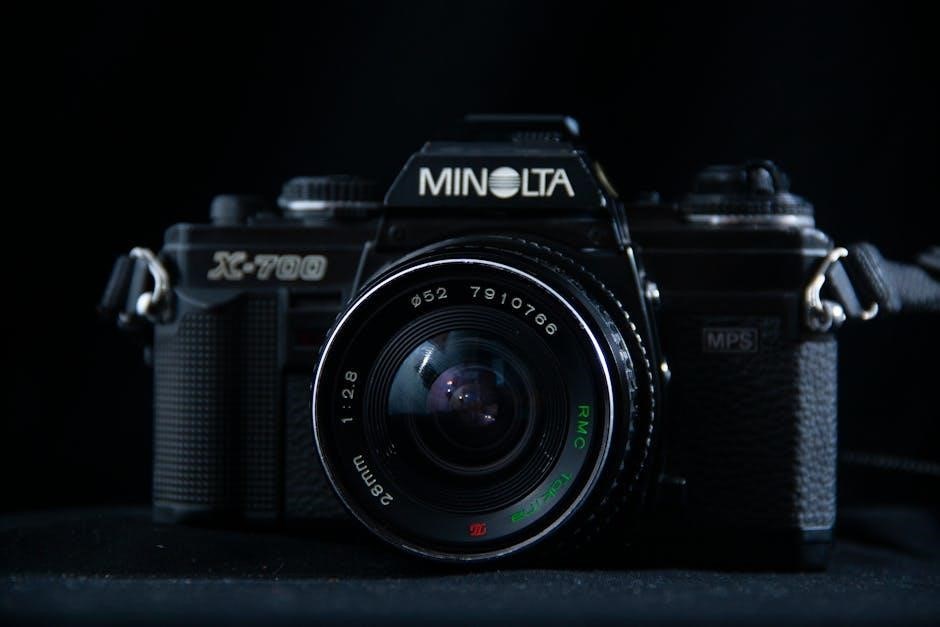
minolta maxxum 7000 af manual

Accessing the Minolta Maxxum 7000 AF Manual

Easily access the Minolta Maxxum 7000 AF manual online or download your free PDF guide instantly․ This comprehensive instruction manual provides expert guidance for setup, operation, and mastering all camera features, ensuring you can start shooting like a pro․

Download the Free PDF Guide

Secure your free Minolta Maxxum 7000 AF manual download today, providing instant access to a comprehensive PDF guide for your classic 35mm film camera․ This invaluable resource is your complete reference for mastering every aspect of the Minolta Maxxum 7000 AF, from initial setup and basic operations to delving into its advanced functionalities and intricate adjustments․ Whether you’re a new owner seeking foundational knowledge or an experienced user looking to refine your skills and troubleshoot specific issues, this downloadable manual offers detailed, step-by-step instructions, presented clearly for easy understanding․ With this expert guidance readily available at your fingertips, you can unlock the full creative potential of your Minolta Maxxum 7000 AF, ensuring you capture stunning photographs with confidence and precision in any situation․ Download your free PDF now and significantly elevate your photography experience․ This comprehensive instruction manual is truly indispensable for both operating and maintaining your camera effectively, guaranteeing optimal performance and longevity for years to come․ It provides all necessary information to utilize your film camera to its utmost capability, empowering every photographer․

View Owners Manual Online

For immediate access to your Minolta Maxxum 7000 AF instruction manual, conveniently view the owners manual online without any download․ This digital format enables instant navigation through comprehensive details about your MAXXUM 7000 camera, directly from your web browser, accessible anytime, anywhere; Explore vital features like the autofocus system, understand LCD data display panels, and master automatic multi-program selection effortlessly․ The online version offers extensive guidance, identical to the PDF, covering camera setup, operation, and essential maintenance․ Quickly find troubleshooting tips and detailed technical specifications․ Some platforms integrate an AI chat feature, providing instant answers to specific film camera questions, enriching your learning․ This viewing option is perfect for quick reference or in-depth study, offering a flexible, user-friendly approach to maximize your Minolta Maxxum 7000 AF’s potential for exceptional photography with unparalleled convenience․

Comprehensive Instruction Manual Download

Acquiring the comprehensive instruction manual for your Minolta Maxxum 7000 AF is a straightforward process, providing you with an invaluable PDF download․ This free, detailed guide is your ultimate companion for truly mastering your 35mm film camera, covering everything from fundamental operations to advanced settings․ With this downloadable resource, you gain in-depth knowledge of the camera’s sophisticated autofocus system, learn how to interpret and utilize the LCD data display panels, and understand the nuances of the automatic multi-program selection for various shooting scenarios․ Beyond core functionalities, the manual meticulously details camera setup and precise operation procedures, ensuring optimal performance from the outset․ It also includes an extensive section on troubleshooting tips, helping you quickly resolve any issues that may arise, alongside crucial maintenance guidelines to preserve your equipment’s longevity․ Furthermore, all technical specifications are presented clearly, offering a complete overview․ This downloadable manual is designed to equip you with the expertise needed to confidently explore creative photography, ensuring you leverage every capability of your Minolta Maxxum 7000 AF and capture professional-quality images with ease․

Minolta Maxxum 7000 AF Camera Features

The Minolta Maxxum 7000 AF boasts an advanced autofocus system, clear LCD data display panels, and automatic multi-program selection for diverse shooting․ Master its features, from basics to advanced settings, with the comprehensive manual․

Understanding the Autofocus System

The Minolta Maxxum 7000 AF was revolutionary for its integrated autofocus system, a key feature that simplifies capturing sharp images․ This advanced technology automatically detects and focuses on subjects, greatly reducing the effort required to achieve critical sharpness compared to manual focus cameras․ The comprehensive instruction manual provides detailed insights into how this system operates, guiding users through its various functionalities and optimal usage․ Understanding the autofocus system is crucial for leveraging the camera’s full potential, especially for dynamic subjects or in situations where quick focusing is essential․ The manual explains how to engage autofocus, select focus modes, and interpret the camera’s feedback for confirming focus․ It covers practical applications, helping photographers understand when and how to rely on the automatic focus for consistent results․ By delving into the manual, users can master this core feature, enhancing their photographic skills and ensuring every shot is precisely in focus․ This detailed guidance transforms novice users into proficient photographers, making the most of the Maxxum 7000’s innovative design․ The ability to quickly and accurately focus was a hallmark of this camera, ensuring every owner benefits․

LCD Data Display Panels

The Minolta Maxxum 7000 AF was renowned for its intuitive LCD data display panels, a significant innovation that greatly enhanced user experience․ These panels provided photographers with crucial shooting information readily, eliminating the necessity to constantly check through the viewfinder for every setting adjustment․ Typically, a main LCD was positioned on the camera’s top plate, offering a comprehensive overview of essential parameters such as the current shutter speed, aperture value, and ISO sensitivity․ It also clearly indicated the selected exposure program mode, battery charge level, and the number of exposures remaining or taken․ Furthermore, a smaller, discreet display within the viewfinder often duplicated key information, like focus confirmation and shutter speed, ensuring critical data was visible even while composing a shot․ This immediate, clear visual feedback was invaluable for making rapid adjustments and maintaining an uninterrupted creative flow․ The clarity and accessibility of these LCD panels streamlined the photographic process, allowing users to concentrate more intently on composition and subject matter rather than fumbling with controls․ Mastering the interpretation of these displays, as thoroughly detailed in the comprehensive instruction manual, was fundamental for efficient and confident camera operation, truly empowering photographers․

Automatic Multi-Program Selection

The Minolta Maxxum 7000 AF distinguished itself with an innovative Automatic Multi-Program Selection feature, a cornerstone of its user-friendly design․ This intelligent system allowed the camera to automatically choose the most appropriate exposure program based on the attached lens and prevailing shooting conditions․ For instance, if a wide-angle lens was mounted, the camera might default to a program ideal for expansive landscapes, whereas a telephoto lens could activate a program prioritizing faster shutter speeds, perfect for freezing action․ This meant photographers were not always required to manually switch between various exposure modes like program AE, shutter priority, or aperture priority․ Instead, the Maxxum 7000 AF intelligently adapted, ensuring optimal exposure settings were applied without constant manual intervention․ This streamlined approach was invaluable for rapid shooting scenarios or for users less familiar with advanced exposure theory․ The system’s adaptive capabilities empowered photographers to focus more on composition and capturing decisive moments, rather than getting entangled in technical adjustments․ A thorough understanding of how this automatic selection functions, as detailed in the comprehensive instruction manual, was crucial for maximizing the camera’s potential and achieving consistently well-exposed photographs across diverse situations․

Advanced Features and Settings

The Minolta Maxxum 7000 AF, while revolutionary for its autofocus, also provided a robust array of advanced features and settings for more discerning photographers․ Beyond its automatic program selection, users gained access to manual exposure control, including shutter-priority and aperture-priority modes, allowing for precise creative manipulation of depth of field or motion blur․ Exposure compensation was a crucial setting, enabling fine-tuning of exposure in challenging lighting, ensuring subjects were perfectly exposed․ The camera supported various ISO sensitivities, either manually set or automatically read from DX-coded film․ Furthermore, the system integrated seamlessly with compatible Maxxum flash units, offering advanced flash control capabilities․ Other sophisticated options included a self-timer and continuous shooting modes, expanding the camera’s versatility for diverse photographic scenarios․ Mastering these advanced functionalities, comprehensively detailed in the official instruction manual, was essential for photographers aiming to fully exploit the Maxxum 7000 AF’s potential and achieve their specific artistic visions․

Operation, Maintenance, and Specifications

This section provides a comprehensive guide to the Minolta Maxxum 7000 AF․ Learn about camera setup, essential operation procedures, and practical troubleshooting tips․ Discover crucial maintenance guidelines and review the detailed technical specifications for optimal performance and longevity․

Camera Setup and Operation

The Minolta Maxxum 7000 AF manual is your indispensable guide for mastering camera setup and operation, transforming you into a proficient photographer․ It provides comprehensive instruction, from the initial steps of loading film and installing batteries to configuring the various shooting modes and customized settings․ You will find detailed explanations on how to smoothly navigate the camera’s intuitive controls, ensuring a seamless and intuitive user experience․ The manual covers everything from basic functions, such as accurately adjusting exposure and precise focusing, to more advanced operational techniques, allowing you to fully utilize the Minolta Maxxum 7000 AF’s impressive capabilities․ Learn to effectively select appropriate aperture and shutter speed combinations, expertly use the built-in light meter, and understand the subtle nuances of different photographic scenarios․ Whether you are setting up for a casual snapshot or a more complex photographic endeavor, this section guides you through each critical operational aspect․ With expert guidance, you can confidently explore and harness the full potential of your 35mm SLR film camera, enabling you to capture stunning images with precision and ease, truly making you shoot like a pro․

Troubleshooting Tips

The Minolta Maxxum 7000 AF manual provides essential troubleshooting tips to maintain optimal camera performance․ If your camera fails to power on, check the battery compartment for corrosion and ensure fresh batteries are correctly installed․ For autofocus problems, such as hunting or failed focus lock, verify sufficient lighting and the AF/MF switch setting․ Should film not advance or produce blank frames, consult the manual’s detailed loading instructions, focusing on leader engagement․ Erratic or unlit LCD data display panels frequently indicate low battery power, so replacement is often the solution․ If an external flash unit does not fire, confirm its secure attachment and full charge․ This guide offers systematic diagnostic steps to efficiently resolve common issues, thereby minimizing downtime․ Mastering these techniques helps you promptly resume capturing your desired photographs with confidence and ease․

Maintenance Guidelines

For optimal longevity and performance, adhering to proper, essential maintenance guidelines is crucial․ Regularly clean the lens elements with a dedicated lens brush and microfiber cloth; avoid harsh chemicals․ Wipe the camera body with a soft, dry cloth to remove dust and grime, paying attention to crevices․ Periodically inspect battery contacts for corrosion, cleaning with a pencil eraser if necessary, to ensure reliable power to its autofocus and display․ When storing the camera for extended periods, always remove batteries to prevent leakage and internal damage․ Store the camera in a cool, dry place, ideally with a desiccant pack, protecting it from humidity and extreme temperatures․ Keep the film chamber clean and free of dust particles that could scratch film or affect image quality․ Avoid exposing the camera to direct sunlight for prolonged durations․ Handle the equipment with care, protecting it from drops and impacts․ Following these simple steps, as outlined in the comprehensive instruction manual, will preserve the valuable photographic tool’s functionality and aesthetic condition, ensuring years of reliable use for capturing memories․ This approach ensures consistent performance across all its features․

Technical Specifications

The Minolta Maxxum 7000 AF manual provides a detailed overview of the camera’s essential technical specifications, crucial for understanding its profound capabilities․ As an advanced 35mm film SLR, it features a pioneering autofocus system, which is precisely detailed in this section․ Users can find information regarding the camera’s precise shutter speed range, from its fastest to its slowest settings, along with flash synchronization speeds․ The manual outlines the compatible lens mount system, specifically the Minolta A-mount, and details the various exposure modes, including its automatic multi-program selection, ensuring versatile shooting options․ Power requirements, including battery type and expected lifespan, are clearly stated․ Physical dimensions and weight are also provided, offering insight into its portability and handling characteristics․ Information on the film type accepted and its ISO sensitivity range allows photographers to select appropriate film for diverse lighting conditions․ Furthermore, specifications regarding the LCD data display panels, including their indications and functionalities, are thoroughly covered․ This section ensures a comprehensive understanding of the camera’s engineering, performance metrics, and operational parameters, enabling users to maximize the potential of this iconic photographic tool for every shot․

Related Flash Unit Manuals

Explore the essential manuals for compatible Minolta Maxxum flash units․ Access guides for the Maxxum 1800AE, 2800AF, and 4000AF flashes to enhance your photographic lighting․ Learn their features and optimize your camera’s performance with these dedicated resources․

Maxxum 1800AE Flash Manual

The Minolta Maxxum 1800AE flash manual is an indispensable resource for photographers using this external flash with their Minolta Maxxum 7000 AF camera․ This detailed guide offers essential instructions on attaching, operating, and troubleshooting the 1800AE flash, ensuring seamless integration and optimal lighting․ Understanding its functions is crucial for achieving well-exposed images in various conditions, especially when the camera’s built-in flash is insufficient․ The manual covers fundamental aspects like battery installation, power settings, flash modes, and synchronization with the camera body․ It elaborates on automatic exposure control, a key 1800AE feature, allowing the flash to communicate effectively with the Maxxum 7000 AF for accurate light output․ Users gain guidance on bounce flash techniques, direct flash usage, and understanding the flash ready indicator․ Furthermore, the manual typically includes safety precautions, maintenance tips to prolong the unit’s life, and technical specifications․ Consulting this manual helps users unlock the full potential of their 1800AE flash, moving beyond basic photography to more creative, controlled lighting․ It ensures photographers confidently capture stunning images, making it a vital companion to the main camera manual for comprehensive photographic mastery․

Maxxum 2800AF Flash Manual

The Minolta Maxxum 2800AF flash manual serves as a vital companion for photographers utilizing this dedicated flash unit with their Minolta Maxxum 7000 AF camera․ This essential guide provides detailed instructions for seamlessly integrating the 2800AF and maximizing its capabilities for improved lighting․ Users will find comprehensive information on proper attachment to the camera’s hot shoe, battery installation, and understanding its operational controls․ The manual delves into the flash’s advanced features, including its TTL (Through-The-Lens) metering system, which ensures precise exposure by measuring light directly from the lens․ It explains various flash modes, fill-flash applications, and techniques for adjusting flash output to suit different photographic scenarios․ Crucially, the manual covers how to utilize the 2800AF’s potential for bounce flash, often detailing head swivel and tilt mechanisms to achieve softer, more flattering illumination․ Troubleshooting common issues, maintenance guidelines, and safety precautions are also thoroughly addressed, ensuring reliable performance and longevity․ Mastering the Minolta Maxxum 2800AF through its manual empowers photographers to confidently enhance their images with controlled, professional-quality lighting, expanding creative possibilities beyond available ambient light․

Maxxum 4000AF Flash Manual

The Minolta Maxxum 4000AF flash manual is an indispensable resource for users looking to optimize their photographic lighting with the Minolta Maxxum 7000 AF camera․ This comprehensive guide provides detailed instructions for integrating and utilizing the powerful 4000AF flash unit effectively․ Within its pages, photographers will discover how to correctly mount the flash onto their camera, understand battery requirements, and navigate the unit’s controls․ The manual clarifies the 4000AF’s advanced capabilities, including its robust Through-The-Lens (TTL) metering system, which automatically ensures accurate flash exposure for diverse lighting conditions․ It explains various flash modes, such as fill-flash techniques for balancing ambient light and shadows, and offers guidance on adjusting flash output․ Furthermore, users will learn about the flash’s enhanced features, potentially including greater power output, faster recycling times, and more versatile bounce and swivel head adjustments for creative lighting angles․ The manual also covers essential troubleshooting tips, proper maintenance procedures, and safety guidelines to ensure the longevity and reliable performance of the flash․ By consulting this manual, photographers can unlock the full potential of their Minolta Maxxum 4000AF, significantly elevating their image quality with professional-grade illumination․